PRESS RELEASE: DUKE AND DUCHESS OF CAMBRIDGE PUT SPOTLIGHT ON TIDAL ENERGY

The Duke and Duchess of Cambridge visited Orkney this week to visit the European Marine Energy Centre (EMEC) in pursuit of solutions for tackling climate change and supporting the UK’s green economic recovery.

Their Royal Highnesses met with EMEC’s managing director, Neil Kermode, and external relationship manager, Eileen Linklater, to hear about the test centre’s role in developing an ocean energy industry and green hydrogen economy. Discussions centred around the potential for ocean energy as a new sustainable energy resource stimulating job creation and supply chain development.

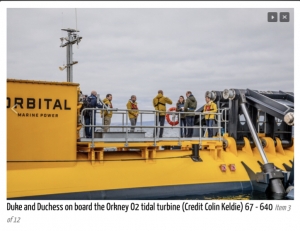
Heading out to sea, courtesy of the Royal Navy, the tour included an excursion to Orbital Marine Power’s O2 – the world’s most powerful tidal turbine. Orbital’s CEO, Andrew Scott, provided a tour on board the O2 with the Duke and Duchess christening the device for good luck with a splash of Scapa Whisky.

Returning to shore, the royal couple visited EMEC’s hydrogen fuel cell and storage trailers at Kirkwall Pier, and were introduced to members of EMEC’s operations team. John Skuse, Jerry Gibson and Dave Wakefield shared stories of their progression from careers in hospital building and engineering, marine engineering and aviation to careers in ocean energy at EMEC, as well as providing an overview of the green hydrogen initiatives taking place in Orkney.

Neil Kermode, Managing Director, EMEC said: “It was a pleasure meeting the Duke and Duchess and introducing them to Orkney’s living laboratory for sustainability and renewable energy. Orkney is a beacon for the world, demonstrating technologies and solutions that will support decarbonisation and a cleaner, greener future.

“From wind, tidal and wave power to green hydrogen for clean carbon-free fuel, we were able to show Their Royal Highnesses sustainable solutions that will help tackle climate change and support green economic recovery, and introduce them to some of the people working in the sector locally. The activities taking place here at EMEC have attracted passionate people to stay in and move to Orkney to build their careers; the epitome of just transition in action.”

Andrew Scott, CEO, Orbital Marine said:
“It’s hugely exciting for the whole team at Orbital to get the attention from the Duke and Duchess of Cambridge on their trip to Orkney. Tackling climate change is something they’re clearly very passionate about so it is a real honour to get the opportunity to show them our innovative O2 turbine and give them an insight into our ambitions to help turn the tide on climate change here in the UK and overseas.”

PTEC and Orbital Marine Power join forces to harness tidal power off the Isle of Wight.

Perpetuus Tidal Energy Centre (PTEC) has signed a pivotal agreement with Orbital Marine Power, Ltd. (Orbital), developers of the world’s most powerful tidal turbine, the Orbital O2, to bring the Isle of Wight a step closer to producing tidal energy.

PTEC has gained offshore consents to place tidal turbines in the sea off the south coast of the Isle of Wight, and Orbital is the first company to sign up, with an initial target deployment of up to 15MW by the end of 2025.

Each of Orbital’s 2MW O2 turbines can generate sufficient clean, predictable electricity to power around 2,000 UK homes and offset approximately 2,200 tonnes of CO2 production per year. The company recently launched the first O2 from the Port of Dundee, where it was manufactured with 80% UK supply chain content, before towing the unit to the Orkney Islands where it will be grid connected at the European Marine Energy Centre in the coming weeks and enter commercial operation for the next 15 years.

Rob Stevens, Chairman of PTEC said: “This is an important moment for the Isle of Wight economy. Having one of the most advanced tidal turbines in the world producing clean, predictable energy on our site will be a huge step forward for Britain and the Island. It will establish the Isle of Wight and the Solent at the centre of an exciting new marine energy sector, unlocking investment, jobs and a new future.

“The Orbital O2 is a remarkable innovation that sets a new benchmark for marine generation. We are thrilled to have the team on board.”

Oliver Wragg, Commercial Director of Orbital said: “This is a fantastic step for Orbital and the UK tidal power sector. This agreement will enable a commercial tidal energy project that will pave the way for tidal steam energy to make a meaningful and complementary contribution to the UK’s transition to net zero. The tidal resource off the Isle of Wight has enormous potential to provide predictable, clean power; and we are excited that PTEC has recognised our proven credibility in delivering world leading tidal energy projects. This project can be the touchpaper that ignites an exciting new UK wide supply chain that secures local jobs as tidal energy plays its part in the energy transition.”

PTEC, Orbital and other industry leaders have worked with the UK Government and we are confident they can create the right market parameters to support the UK tidal energy sector. The partners are hopeful that when the Department for Business Energy and Industrial Strategy (BEIS) opens its fourth Allocation Round for Contracts for Difference (CfDs) in December this year, it will include provisions for enabling a new green industrial sector to be built within the UK.

For more information see perpetuustidal.com.

Ends.


The O2 tidal turbine

The O2 tidal turbine

Media contacts:

PTEC: Kelly Linay: kelly@athene-communications.co.uk or 07748 793509

Orbital Marine Power: Sarah Watt, Marketing and Media Manager: s.watt@orbitalmarine.com

Notes to editor:

Tidal energy contributes to UK and international targets for renewable energy generation and PTEC will help achieve the government’s declared objective of Net Zero by 2050. It is estimated that the tides around the Isle of Wight have the capacity to generate around 300MW of renewable power.

Last year Kwasi Kwarteng, the Secretary of State for Business, stated that he was considering ring-fencing capacity in the next Contract for Difference round for wave and tidal energy projects. The Secretary said he is “very sympathetic” to running a “pot within a pot” to support development of marine energy schemes. This commitment is crucial if tidal power is to reach its potential in the UK.

PTEC, EMEC and Orbital are seeking to maximise the potential of the site, which is located in a 5km² area within the English Channel, approximately 2.5km south of St Catherine’s Point and around 6km from Ventnor. A public consultation will launch shortly to explain the proposals in full and seek the community’s views. While the offshore part of the project is consented, PTEC is reapplying for planning permission for its onshore substation.


About Orbital Marine Power Ltd.

Orbital Marine Power Ltd is an innovative Scottish engineering company, headquartered in Orkney, and focused on the development of a tidal energy turbine technology capable of producing a dramatic reduction in the cost of energy from tidal currents. The Orbital technology has been under continuous engineering development, including rigorous testing of scaled systems in both tank conditions and open ocean environments since the company was founded in 2002. The company currently employs 32 staff with offices in Orkney and Edinburgh.

The O2 turbine has a long hull structure with twin 1MW power generating nacelles at the end of retractable leg structures designed to give low-cost access to all major components for through life servicing. 10m blades give the O2 more than 600m² of swept area to capture flowing tidal energy. The floating structure is held on station with a four-point mooring system where each mooring chain has the capacity to lift over 50 double decker buses. Electricity is transferred from the turbine via a dynamic cable to the seabed and a static cable along the seabed to the local onshore electricity network.

The O2 project has been supported through funding from the European Union’s Horizon 2020 research and innovation programme under the FloTEC project and the European Regional Development Fund through the Interreg North West Europe Programme under the ITEG project. This project has also received support under the framework of the OCEANERA-NET COFUND project and co-funding by the European Union’s Horizon2020 research and innovation programme. The build of the O2 was also supported by the Scottish Government under the Saltire Tidal Energy Challenge Fund.

www.orbitalmarine.com


PTEC Launch #turnthetideontidal Campaign Dec 20

The aim of this campaign is to direct members of the public to a UK Gov petition to ‘Commercialise the UK Tidal Stream Industry with Government Revenue Support’. Previous support (CfD minima) was removed by The Government in 2016. The campaign was launched across social media platforms on 26th September 2019.

This campaign does not specifically ask for reinstatement. It leaves all options open, whether to revert to the original legislation (CfD minima), an innovation CfD (iCfD) or a tax relief system through an Innovation Power Purchase Agreement (IPPA). The end goal is to provide a ‘route to market’ for tidal stream energy and encourage investment in tidal energy projects around the UK.
The campaign is designed to alert the public to the fact that tidal energy is the UK’s least known renewable resource which could contribute to net zero carbon emissions by 2050 as well as create a thriving industry (worldwide, it is forecast that ocean energy could be worth £76 billion by 2050). Tidal energy is by no means a solution by itself, but it alone has the potential to supply a high volume of predictable renewable energy to the UK National Grid. Unlike other renewable energy sources tidal energy is predictable with very strong environmental credentials. The UK holds 50% of the European resource and currently leads the world in both tidal energy research and technology, meaning commercial opportunities are plentiful. We have a number of companies with commercially rated turbines ready to deploy, but without government support investors are reluctant to invest and the UK economy continues to miss out on an incredible opportunity to generate growth, jobs, investment and a commanding global market share. Whilst at the same time reviving many of our long neglected coastal communities and marine industries.
Our wider hope is that this campaign will get the public thinking about the broader picture on renewable energy and to ultimately kickstart renewed investment in marine energy sector.
At a time when there is so much national attention on solar and wind energy, we feel it’s important to draw attention to an additional capability, so that we may build a robust, multifaceted energy system that ensures that UK plc generates the energy to meet our future needs whilst improving our market share and our position as a world leader in renewable technology and innovation.

Links 

PTEC Launch #turnthetideontidal Campaign

The campaign was launched across social media platforms on 26th September 2019. The aim of the campaign is to direct members of the public to a UK Gov petition to ‘Commercialise the UK Tidal Stream Industry with Government Revenue Support’. Previous support (CfD minima) was removed by the government in 2016. This campaign does not specifically ask for reinstatement. It leaves all options open, whether to revert to the original legislation (CfD minima), an innovation CfD (iCfD) or a tax relief system through an Innovation Power Purchase Agreement (IPPA). The end goal is to provide a ‘route to market’ for tidal energy and encourage investment in tidal energy projects around the UK.

The campaign is designed to alert the public to the fact that tidal energy is the UK’s least known renewable resource which could contribute to net zero carbon emissions by 2050 as well as create a thriving industry (worldwide, it is forecast that ocean energy could be worth £76 billion by 2050). Tidal energy is by no means a solution by itself, but it alone has the potential to supply a high volume of predictable renewable energy to the UK National Grid. Unlike other renewable energy sources tidal energy is predictable with very strong environmental credentials. The UK holds 50% of the European resource and currently leads the world in both tidal energy research and technology, meaning commercial opportunities are plentiful. We have a number of companies with commercially rated turbines ready to deploy, but without government support investors are reluctant to invest and the UK economy continues to miss out on an incredible opportunity to generate growth, jobs, investment and a commanding global market share. Whilst at the same time reviving many of our long neglected coastal communities and marine industries.

Our wider hope is that this campaign will get the public thinking about the broader picture on renewable energy and to ultimately kickstart renewed investment in marine energy sector.

At a time when there is so much national attention on solar and wind energy, we feel it’s important to draw attention to an additional capability, so that we may build a robust, multifaceted energy system that ensures that UK plc generates the energy to meet our future needs whilst improving our market share and our position as a world leader in renewable technology and innovation.

SIGN THE PETITION herehttps://petition.parliament.uk/petitions/274868

Links 

MET-CERTIFIED: Boosting Marine Energy Projects

​Through its Interreg 2 Seas Programme, Europe will contribute 5,6 million euro to the MET-CERTIFIED project to accelerate the deployment of marine energy projects. MET-CERTIFIED is run by a consortium of European industrial, governmental and academic partners.

In July 2016, the Interreg 2 Seas Monitoring Committee gave the green light to MET-CERTIFIED, which stands for “Development of International Standards and Certification Schemes for Marine Energy Technologies”.

MET-CERTIFIED aims to increase the adoption of insurable and therefore bankable marine energy projects through the development of internationally recognised standards and certification schemes and by testing and verifying technologies against IEC standards for marine energy convertors.

Peter Scheijgrond, project manager of the MET-CERTIFIED project said: “This project answers one of the main recommendations from the Ocean Energy Forum Strategic Roadmap. Certification can help to reduce perceived risks of the technologies in terms of performance and structural integrity, and thus helps to attract debt financing and make export much easier. At present no certification scheme for marine energy has been developed and implemented by all main stakeholders in a consistent way.

“The expectation is that it will come into existence over the next three years under the umbrella of the International Electrotechnical Commission (IEC). The timing of MET-CERTIFIED is therefore very favourable.”

Scheijgrond continues: “With the funding we can actively involve stakeholders around certification, from banks and insurers to consenting authorities, end-users, test facilities and classification bureaus. We will start with verifying existing pilot projects against the IEC standards. For example, the tidal power plant in the Eastern Scheldt Storm Surge barrier will be used as a reference case for certification.

“By applying the standards and certification schemes on such projects we will receive valuable feedback to improve the IEC products. Next we will go through the process of certification: from concept to construction to installation of a full-scale floating platform for tidal turbines.

“We expect this will result in robust standards and certification schemes for the sector, and reduce the perceived risk associated with marine energy projects. This in turn will increase interest from large investors, enabling the sector to deploy large marine energy projects.”

MET-CERTIFIED brings together partners from 4 European countries to advance the marine energy sector in the 2SEAS region: Tidal Testing Center (NL) as project coordinator, the European Marine Energy Center (UK), Lloyd’s Register EMEA (UK), IFREMER (FR), Tocardo Tidal Power (NL), Perpetuus Tidal Energy Centre (UK), NEC (NL), DNV GL (UK), Regional Development Agency West Flanders (BE), Ghent University (BE).

Facts
MET-CERTIFIED is receiving funding from the Interreg 2 Seas programme 2014-2020, co-funded by the European Regional Development Fund under subsidy contract No 2S01-020. Also the Ministry of Economic Affairs in the Netherlands, the provinces of South and North Holland and the Belgian Province of West Flanders are offering financial support.

Interreg 2 Seas Programme:
Interreg 2 Seas is a European Territorial Cooperation Programme covering England, France, the Netherlands and Belgium (Flanders). The Programme is part-financed by the European Regional Development Fund and has a total of €241m ERDF to co-finance projects in the 2014 – 2020 period.

The overall objective is to develop an innovative, knowledge and research based, sustainable and inclusive 2 Seas area, where natural resources are protected and the green economy is promoted. In order to realise this, projects that directly contribute to one of the specific objectives (such as “Low Carbon Technologies”) can be part-financed for up to 60 % of their total project budget.

Read the full press release

PTEC partners with world-leading and state-of-the-art tidal turbine manufacturers

Perpetuus Tidal Energy Centre (PTEC) today announced its major partnerships with global tidal turbine manufacturers, SCHOTTEL HYDRO GmbH and TOCARDO Tidal Turbines. The transformational tidal energy generation project, having achieved all key project consents earlier this year and with a signed grid connection offer, is now a step further towards delivery with full operations to commence from 2020.

The 30MW project, to be created off the Isle of Wight, will allow long-term operation of SCHOTTEL HYDRO and TOCARDO turbine arrays, simultaneously optimising their performance and delivering reliable electricity to the grid. PTEC is also expected to create and safeguard hundreds of jobs and attract significant investment into the local economy, building on the success of the existing British marine and offshore wind sectors.

Project Director, Mark Francis said: “We are very pleased to announce that TOCARDO and SCHOTTEL HYDRO are partnering with us to deliver 30MW of predictable electricity generated from the tidal currents to the south of the Isle of Wight. This is a major milestone for the project, which is of strategic importance to the UK’s tidal industry and will accelerate the growth of the sector as well as enable a continued cost reduction path for future tidal stream projects. Working with world leading and state-of-the-art turbine manufacturers under our unique project structure will be the key to our success.

We are currently working with SCHOTTEL HYDRO and TOCARDO to identify the optimal site layout and designs, taking into consideration the outputs of our Environmental Impact Assessment and consented envelope. These decisions will be finalised in due course, with onshore construction scheduled to begin next year.”

Niels A. Lange, MD from SCHOTTEL HYDRO said: “It is a privilege to be part of the largest consented tidal stream energy project in England and Wales. We are excited to join such a ground-breaking development and world-class team and look forward to seeing PTEC drive the development of tidal power both in the Solent area and, indeed, worldwide.

We will be spearheading this development through our UK subsidiary TidalStream Ltd., which has been active in this industry for over five years. One of the benefits of our TRITON platform technology is the maximising of local manufactured content. For our demonstrator in the Bay of Fundy, Nova Scotia – due to be installed next year – the local content will be in the order of 75%, bringing manufacturing jobs and benefits to the local community. We are constantly seeking ways to advance our technology and ensure it is fully commercialised for worldwide production. PTEC is the perfect opportunity for us to achieve this.”

Hans van Breugel, CEO of TOCARDO said: “Engaging with PTEC is a significant step in the commercialisation process of TOCARDO’s standard offshore tidal solution, the UFS. After having deployed our turbines at various sites in the Netherlands and operating these projects successfully, we feel confident to jointly realise this world leading multi-MW tidal energy farm at the Isle of Wight. PTEC follow a thorough step-by-step process towards successful project deployment, just like TOCARDO does in product development, and we are proud to have been selected.”

schottel-logotacardo-tidal-power-logo

World Leading UK Tidal Power Project Gains Approval

A state-of-the-art tidal energy generation project to be constructed off the Isle of Wight has today been given approval. The Marine Management Organisation has given the go-ahead to the offshore elements of the Perpetuus Tidal Energy Centre (PTEC). With the onshore part given local planning consent in September 2015, the project at 30MW is now the largest consented tidal stream energy project in England and Wales. It has also secured its future connection to the UK’s electricity grid.

PTEC is now set to become a world leader in large-scale tidal power production, using the motion of the changing tides to generate clean and reliable electricity for the UK.

PTEC will commercially operate a range of different world-leading turbine technologies in a five square kilometre area off St Catherine’s Point, the southernmost tip of the Isle of Wight. The project will bring international companies to the UK and accelerate the country’s adoption and understanding of tidal energy.

A number of tidal turbine manufacturers have already expressed interest in partnering with PTEC to install their turbines. Once operational, PTEC will generate sufficient clean electricity to power more than 15,000 homes.

Evidence from other tidal energy projects suggests that PTEC could also create or safeguard hundreds of jobs and attract significant investment into the local economy. Opportunities for businesses on the Isle of Wight and around the Solent area will be generated both in the construction and operational stages of the project.

Project Director Mark Francis said:

“We are delighted with the decision. PTEC will be pivotal to the future growth and success of the UK’s tidal energy industry.

“We started work on the PTEC project back in 2010 and secured the seabed Agreement for Lease in November 2012. Following a rigorous development and consenting phase, we have created a project that will deliver reliable power to the UK’s grid and has attracted world leading turbine manufacturers to partner with us in its implementation.

“We now look forward to working with the MMO, local planning authority and all relevant stakeholders in completing the final development phase before we begin construction.”

PTEC is operated as a joint venture between private company, Perpetuus Energy Ltd, and the Isle of Wight Council. It is hoped that the construction of the project will start in 2017, with potential to be generating electricity from late 2018.

TIDAL energy onshore plans for a Ventnor site have been given planning permission by the Isle of Wight Council

Statement from Mark Francis, Project Manager:

We are delighted with the decision last night (8th September 2015) to grant planning permission for the onshore elements of the project. PTEC has gone to great lengths to ensure the substation has a minimal visual impact on the surrounding area, which is why it has been designed with a living roof and will be built from local natural stone and wood.

Our application for the offshore elements of the project is still being considered by the Marine Management Organisation (MMO), however, we have recently proposed to significantly reduce the maximum allowable height of the tidal devices from 18 metres above water to 9 metres. These changes have been accepted by the MMO and we expect the MMO to make an announcement on the consent determination later this year.

Perpetuus Tidal Energy Centre moves a step closer to becoming a world leading multi technology tidal array demonstration facility

The Local Planning Authority has today given the green light for outline planning for the onshore elements of the Perpetuus Tidal Energy Centre (PTEC).

A planning application was submitted to the Isle of Wight Council in November last year for a substation and associated infrastructure in Ventnor. The planning committee has today, 9th June 2015, passed outline plans for it to be built on existing development land close to Flowers Brook.

This is the first phase of the project; an application for the offshore elements is being considered by the Marine Management Organisation (MMO), and PTEC will now work to achieve full planning from the Local Planning Authority

Project Manager Mark Francis said, “We are delighted with today’s decision. We are really excited by this project and the potential it has to benefit not just the Island and its residents, but the UK more widely. We are working closely with the Marine Management Organisation and we expect a decision later this year. We hope to have the site operational by 2018.”

The total electrical output from the site is expected to be around 65,000 MWh per year which will provide enough clean electricity to power the equivalent of over a quarter of Isle of Wight homes. PTEC will also be investing in grid upgrades for the Island, which will help enable the development of other renewable energy projects on the Isle of Wight.

David Cameron confirms support for Perpetuus Tidal Energy Centre (PTEC)

In Prime Minister’s Questions today Mr Andrew Turner, MP for the Isle of Wight, asked if David Cameron would join him in supporting the Perpetuus Tidal Energy Centre,  a public / private partnership. Mr Turner explained the centre, based on the Isle of Wight, will provide the world’s leading grid connected tidal array test facility, placing the UK at the forefront of tidal energy technology, protecting existing jobs and creating several hundred new ones.

The Prime Minister confirmed the UK is now the most attractive market in the world for investment in offshore wind and in marine renewables. He stated, “We want to maintain that world leading position. We want to harness the economic benefits and the environmental benefits that brings and we want to see local centres of expertise and from what I can see the Perpetuus Tidal Energy Centre sounds like exactly the sort of exciting initiative that we should be supporting.”